Coffee Stories · History
A brief history of coffee: From Ethiopia to the world
A thousand-year journey in one cup.
5 min read
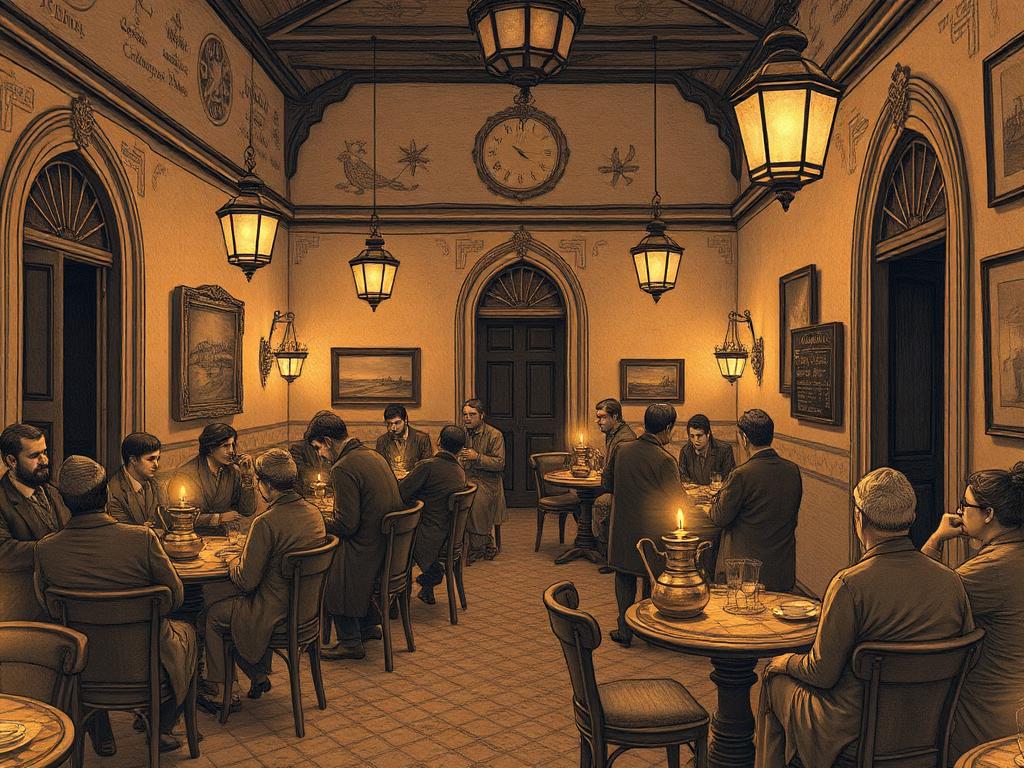
Every day, humanity drinks more than two billion cups of coffee. It is the fuel of mornings, meetings, friendships and revolutions — literally, as we will see. But the bean's journey from an Ethiopian forest to your cup took over a thousand years, and almost every stop along the way left a mark you can still taste today.
The story begins in the highland forests of Ethiopia, where Coffea arabica grows wild to this day. Legend credits a goatherd named Kaldi, who noticed his goats dancing with unusual energy after nibbling red berries from a certain shrub. A skeptical monk supposedly threw the berries into a fire, the roasting beans released their now-familiar aroma, and history changed. The tale is almost certainly invented — it first appears in print centuries later — but the kernel of truth stands: people in the Ethiopian highlands were chewing, steeping and eventually roasting coffee long before anyone wrote about it.
Coffee's first great leap was across the Red Sea to Yemen, sometime around the 15th century. There, Sufi monks brewed it to stay awake through long nights of devotion and chanting. They called the drink qahwa — the root of the word "coffee" in nearly every language on Earth: kahve in Turkish, caffè in Italian, koffie in Dutch. The Yemeni port that shipped these precious beans to the world was called Mocha, a name that still clings to chocolate-coffee drinks for reasons of flavor association centuries old.
Yemen guarded its monopoly jealously. Exporting fertile beans was forbidden; everything shipped was boiled or roasted first. Naturally, smuggling followed. By the early 1600s, a pilgrim named Baba Budan is said to have taped seven fertile seeds to his chest and carried them to southern India, while Dutch traders acquired living plants and established plantations in Java. The monopoly was broken, and coffee began circling the globe.
Meanwhile, the drink itself was conquering cities. Coffeehouses opened in Mecca, Cairo, Damascus and, most famously, Constantinople, where the Ottoman capital's kahvehane became engines of conversation, poetry, chess and politics. Authorities were repeatedly alarmed — a place where men gathered, stayed sober and discussed ideas was considered dangerous, and coffee was banned more than once in both the Ottoman Empire and Mecca. The bans never stuck. They never do.
Europe met coffee in Venice in the early 1600s, and controversy arrived with it. Clergy urged Pope Clement VIII to condemn the "bitter invention of Satan." The pope asked to taste it first, and — so the story goes — declared it too delicious to leave to the devil. Within decades, coffeehouses had spread to London, Paris, Vienna and Amsterdam. London's were nicknamed "penny universities": for the price of a cup, anyone could sit among merchants, scientists and writers. Lloyd's of London, the insurance giant, began as Edward Lloyd's coffeehouse, where ship owners and underwriters met. The London Stock Exchange has similar caffeinated origins.
Coffee even played a supporting role in the American Revolution. After the Boston Tea Party in 1773, drinking tea became unpatriotic in the American colonies, and coffee inherited the national morning. The United States remains one of the world's largest coffee consumers.
The 18th and 19th centuries carried coffee across the tropics — to the Caribbean, Central and South America — often on the backs of enslaved and exploited labor, a dark chapter that shaped global inequalities still visible in the coffee trade today. Brazil, planted with coffee in the 1720s, grew into the colossus of production and has been the world's largest grower for over 150 years. Vietnam, a newcomer that embraced Robusta in the 20th century, now ranks second.
The 20th century industrialized the cup. Instant coffee, perfected around the world wars, put coffee in every pantry and every soldier's ration. Espresso machines, invented in Italy at the century's start, compressed brewing into thirty seconds of theater and gave the world cappuccinos, lattes and the café counter culture of Milan and Rome.
Then came the waves. What historians of coffee call the first wave was mass availability — tins of ground coffee in every supermarket. The second wave, led from 1970s Seattle by a company named after a Moby-Dick character, turned coffee into an experience and taught millions to say "latte." The third wave, from the early 2000s onward, treats coffee like wine: obsessed with origin, variety, processing and roast, printing farm names and tasting notes on every bag. If you have ever been handed a pour-over and told about its "notes of bergamot," you have surfed the third wave.
And the story keeps moving — in an interesting direction for this region. The Middle East, where coffee culture began, is now one of the world's most dynamic specialty coffee markets. The UAE in particular has become a genuine café destination, with home-grown roasteries and independent cafés that stand comparison with any coffee city on Earth. Gulf hospitality never stopped revolving around gahwa, the cardamom-scented Arabic coffee poured from a dallah pot; Emirati and Gulf coffee traditions are even inscribed on UNESCO's list of intangible cultural heritage. In a sense, specialty coffee here is not an import — it is a homecoming.
So the next time you order a flat white or brew a morning cup, consider what you are holding: an Ethiopian forest berry, carried by Sufi monks, smuggled by pilgrims, argued over by popes and sultans, taxed into revolutions, industrialized, then rediscovered as a craft. A thousand years of history, and it still takes just minutes to drink. Some rituals earn their place.